
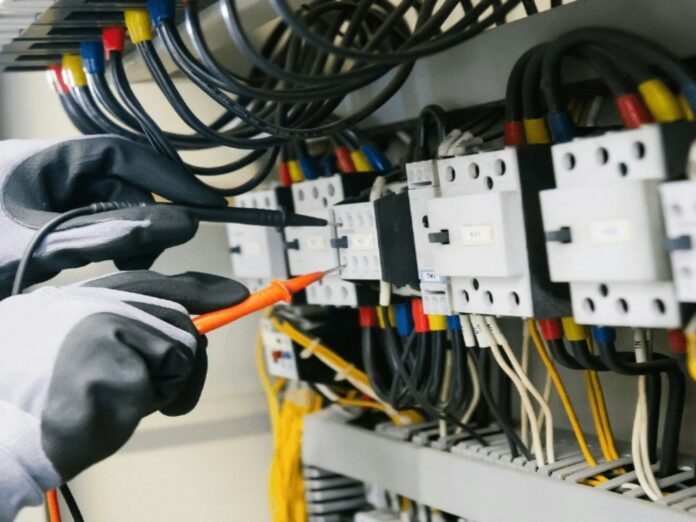
If you live in Maryland and want a career that pays well without requiring a four-year degree, becoming an electrician is a good move. Local construction is moving fast, and there is a constant need for people who know how to handle electricity and come to the rescue when something goes wrong. It looks complicated, but starting as a beginner electrician in MD is as simple as long as you know where to find the right training.
Maryland’s infrastructure requires constant talent. However, you can’t just pick up a set of screwdrivers and start charging for service. The path to becoming a beginner electrician MD involves a few years of classroom theory and hands-on field hours. Once you know what path fits you, you’ll have a clear route to good earnings and stability in your region.
Electrician Salary MD
For many people, the most pressing question is definitely if the paycheck is worth the physical labor. While you might get a different answer if you ask different people, we believe that it’s a yes. Maryland remains one of the top-paying states in the region for electrical work due to its high cost of living and the technical complexity of projects near the capital.
An entry-level electrician starts with a salary between $46,000 and $54,000 for their first couple of years. This is a phase where you get paid to learn, which is a rare perk compared to most career starts. When you start a journeyperson role, salary gets closer to $70,000/$80,000 range. And for master electricians, earnings over $100,000 is a very realistic goal, especially in areas with demand.
According to the U.S. Bureau of Labor Statistics, the demand for skilled workers grows faster than almost any other traditional work.
Top-Rated Electrical Courses in MD for Beginners
In Maryland, like in many other states, there are several different paths to licensure. Depending on your current schedule and financial situation, one of these three will likely fit your needs.
The Community College Route
In community colleges, you can find a balanced place where you gain college credits and technical skills. This is what you should look for you want a formal Associate of Applied Science (A.A.S.) degree.
- Montgomery College
Their Building Trades Technology program focuses on residential and commercial wiring. It’s an excellent place to start if you want to understand the theory better before you do actual training.
- College of Southern Maryland (CSM)
CSM offers specialized electrical courses that align with apprenticeship standards. Their facilities allow students to practice in labs that mimic real-world job sites.
Union Apprenticeships (IBEW)
The International Brotherhood of Electrical Workers (IBEW), specifically Local 26 (covering DC and MD) and Local 24 (Baltimore), provides what many consider the best of electrical training.
This is a “Joint Apprenticeship and Training Committee” (JATC) program. You do not pay tuition, you work for a union contractor during the day and attend classes at night.
But there’s a catch, though. Here, the entrance is highly competitive. You must pass an aptitude test with algebra and reading. You can find more details at the Electrical Training Alliance.
Private Trade Schools and Associations
If you prefer ot move faster or work for a non-union shop, organizations like IEC Chesapeake are invaluable. They represent independent electrical contractors and run one of the largest apprenticeship programs in the country.
What a Beginner Electrician MD Needs to Know
Transitioning into this field is also a shift in mindset. You will spend a significant amount of time with the National Electrical Code (NEC). This book is the legal standard for all electrical work in the United States. A quality electrician course in Maryland will teach you how to navigate this dense manual, so your work stays up to code and passes inspection. If you want to know more tips for a beginner, this article is of great help.
Skills you’ll learn:
- Read blueprint
- Bend pipe
- Circuit theory
If you are aiming for your first major professional milestone, the Journeyperson license, the Maryland Department of Labor requires 8,576 hours of training.
Tip: Keep a log of your work hours from day one. You will need your supervising Master Electrician to verify these hours when you finally apply for your exam. The state is very strict about these numbers because they want you to have seen almost every possible scenario.
Final Thoughts
You don’t need to rush the path to an electrician career. It takes four to five years to become a Journeyperson, and even more if you want to specialize. However, unlike other career paths, you gain seniority and pay raises every single year you stay in the trade. If you possess a mechanical mind and do not mind a bit of hard work, the electrical trade provides job security that is rare in the modern economy.