
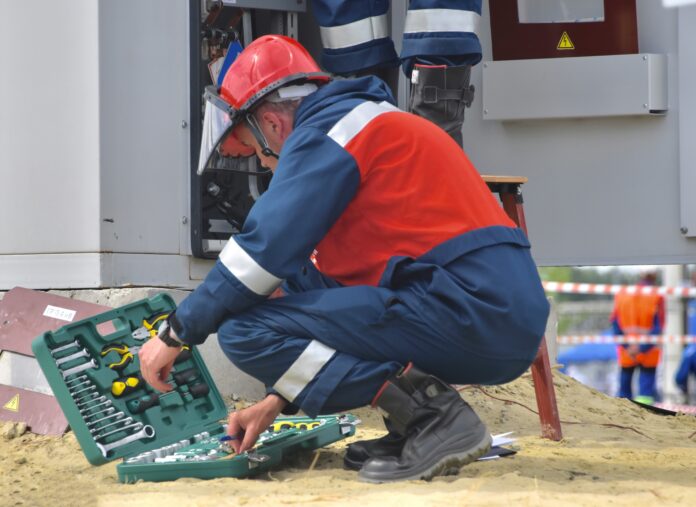
It is a mistake to assume that an electrician is a worker who knows a little bit of everything, or that he lacks true mastery in any specific area. In the electrical world, attempting to do everything is actually a liability. The field is too vast, and the safety codes are too dense for one person to know every niche perfectly. Instead, this industry demands specialization, done during training and through continuous education. Whether you look at a residential or a commercial electrician’s path, success comes from working hard toward your goal.
Key Differences Between Residential and Commercial Electricians
The most immediate difference is in the environment and the materials. Residential work is primarily wood-frame construction. You spend your days in houses or apartments, working with single-phase power (120V and 240V). The wiring method involves non-metallic sheathed cable. It is lightweight, flexible, and simpler to install through wooden studs.
On the other hand, commercial work shifts to steel-frame buildings. Instead of plastic-coated wire, you install electrical metallic tubing (EMT) or heavy-duty conduit, and need to have more experience with pipe bending. Commercial systems run on three-phase power, which provides more consistent energy for large-scale equipment but needs more safety protocols.
The pace of work also varies. Residential projects move quickly, a service call might take two hours, while a full house wire might take a week. Commercial projects sometimes span months or years on a single job site.
Choosing the Right Electrician for Your Home
When you face an electrical issue at your own property, the distinction between these specialties is less about theory and more about the reality of the job site. While a commercial worker possesses many skills, they may lack the specialized tools required to pull a circuit through a ceiling without causing unnecessary damage.
Residential specialists focus on domestic life. They understand the sensitivity of Arc-Fault Circuit Interrupters, which prevent house fires, and they stay current on the National Electrical Code (NEC) requirements for kitchens and bathrooms. For those interested in the career, residential is also a path to entrepreneurship. Many men find that owning a small van and a local client base gives a level of autonomy that corporate commercial work lacks.
For more on home safety standards, the National Fire Protection Association (NFPA) has the residential codes.
The Importance of Hiring an Industrial Electrician
The difference between industrial vs residential electrician work is perhaps the biggest contrast in the industry. While a residential electrician deals with comfort and convenience, an industrial electrician deals with complex production.
Industrial electricians work in high-stakes environments:
-
Manufacturing plants: Maintaining assembly lines that cannot afford a minute of downtime.
-
Refineries and mills: Working with high-voltage motors and complex control systems.
-
Automation: Programming the logic controllers that dictate how a factory moves.
The stakes here are more on the economic side. If a residential circuit fails, you get an inconvenience. If an industrial motor fails, a company loses tens of thousands of dollars per hour. This path requires a deep understanding of process control and safety. It is a rigorous, demanding field, but it offers the highest compensation within the trade.
Understanding the Unique Needs of Commercial Electrical Work
Commercial electrical is the backbone of our public infrastructure. From the hospital where you receive care to the retail center where you shop, the electrical requirements are immense. These buildings must accommodate hundreds or thousands of people, which means safety stays on top at all times.
Infrastructure and safety
In a commercial setting, you encounter fire-alarm systems that are far more complex than a battery-operated smoke detector. These systems must integrate with HVAC units to shut down fans if smoke is detected, preventing the spread of fire through a building. Both deal with safety, but one has to take into consideration not just a few people, but up to thousands.
Durability
Commercial components are built to spec-grade standards. The outlets and switches are designed for a lifespan of decades under constant use. A commercial electrician spends a lot of time making sure that the load is balanced across three phases to prevent overheating of the building’s main transformer. Fr resources, Electrical Safety Foundation International (ESFI) has the differences in safety equipment used in these sectors.
The Path to the License: Navigating the Red Tape
Before you can work, you have to satisfy the jurisdiction, your state or municipal licensing board. The legal requirements for a residential vs commercial electrician are very similar.
Most states require a five year apprenticeship. This is a structured program where you log thousands of hours under a Master Electrician.
-
Residential: The track to a residential Wireman license can be shorter.
-
Commercial/Industrial: These typically require a full journeyman license.
The Journeyman exam is notoriously rigorous. It isn’t a test of memory as much as it is a test of your ability to navigate the theory under pressure. If you pursue this, expect heavy questions on motor calculations, transformer grounding, and location wiring. For a clear breakdown of the process, you can follow these Steps on How to Get an Electrical License in Your State.
Continuing Education
The learning never stops. Every three years, the National Electrical Code is updated. To keep your license, you must attend code update classes. This way, authorities make sure your knowledge isn’t out of date as technology like solar arrays and EV charging infrastructure evolves.
Final Thoughts
The choice between trades comes down to your own personality and what you want your daily life to look like. If you value working alone and the satisfaction of solving a neighbor’s problem, the answer is the residential path. You set your schedule and work how you want to, on your own. However, if you prefer major construction and the logic of blueprints, the commercial sectoris a better fit. The electrical trade is one of the few careers left where your value is tied to your knowledge and your word. Regardless of what you choose, you are entering a profession that is the foundation of modern life.