
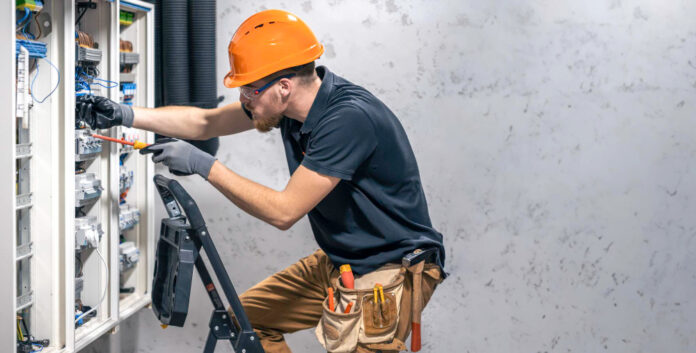
Over the past few years, something has shifted in the way people think about work. Technology is reshaping offices and entire industries are changing, so people are taking a second look at careers built on real, hands-on skills. It’s a resurface of the jobs you learn once, sharpen over time, then carry with you wherever you go.
Most people don’t set out with a perfectly mapped plan when they start looking into how to become an electrician, it starts with a simple realization. Office work isn’t for everybody, and four-year college degrees don’t lead to what people expect. We are starting to realize that skilled work produces visible results and offers steady demand, especially in regulated trades, which show strong national employment rates.
Becoming an electrician in the United States follows a defined path, even though it can look a little different for everyone. The only consistent things are training, supervised experience, and state licensing. No shortcuts, but there is a definitive clarity once you understand how the system works. If you’ve been thinking how can I become an electrician or what training is required to become an electrician, this guide will help you with all the general information you might need. For more info about specific state regulations, check our other articles here.
-
The Path to Becoming an Electrician
When you work with such delicate and important systems, everything should be by the book. Electricians progress through a system that’s designed to keep work safe and competent. While specific rules vary state by state, the career ladder looks similar across the country:
- Apprentice electrician
- Journeyman electrician
- Master Electrician
If you are asking yourself, ‘How do I become an electrician?’ but have no prior experience, the answer is almost always to begin as an apprentice. Apprentices work under the supervision of licensed electricians while completing the required classes and training.
Is an electrician career a good fit?
The job combines physical work with problem-solving, requires meeting strict safety standards, and complying with the electrical code. You’ll have to install, maintain, and repair systems, as well as calculate and troubleshoot. It’s physically demanding at times and involves working on ladders, in confined spaces, or in old buildings. So these are things to take into consideration, besides all of the good parts, such as high salary and steady work.
Many people researching how do u become an electrician are those who are changing careers later in life. This is proof you don’t have to worry you started this too late. This is common and very often successful.
Job Demand in the United States (With Real Salary Insights)
If there is one thing that everyone agrees on, from construction managers to homeowners, it is that skilled electricians have been and will always be in demand. Actually, the U.S. Bureau of Labour Statistics projects an 9% growth for electricians from 2024 to 2034. It means roughly 81,000 job openings are expected annually, mostly because experienced electricians are retiring and there are not enough newly trained workers to take their place.
With strong demand comes strong pay:
- Apprentices usually start at around $35,000 to $45,000 per year
- The median annual pay is about $60,000
- The top 10% of earners made over $106,000 per year.
The salary isn’t uniform across the entire country. Urban areas, union jobs, and work tied to specialized electrical systems like solar or data centers tend to pay more than small residential service work. But electricians in the U.S. are still above the national median wage for all occupations, which is a reason why so many are taking a serious look at this career.
2. Essential Steps to Becoming an Electrician
If you are asking what to do to become an electrician, the steps are straightforward, even if it takes time to complete.
-
Meet the Basic Requirements
Before beginning format training, you typically must:
- Be at least 18 years old;
- Hold a high school diploma or GED
- Be legally authorized to work in the U.S.;
Another important thing is to have basic math skills, especially algebra. Electrical work requires a lot of measurements, calculations, and problem-solving. Those looking into how to become a electrician should not overlook this. Here you can find out more about the basic requirements for electrician apprenticeships.
2. Choose between a trade school and a direct apprenticeship
We know you might want to know which path is the best for you, and the truth is that it depends a lot on your circumstances.
Trade school, on one hand, provides structured education in electrical theory, safety, and real skills, and its programs run from several months to several years. But on the other hand, trade school may not always be required, but it can make your apprenticeship applications more competitive.
Direct apprenticeship takes the other path, combining paid work with education. If you wanted to know how to become electrician without taking on student debt, this is the most appealing route.
With any of these options, you can later apply to get a license.
3. Apply for an Electrician Apprenticeship
Once you have decided on what you want to do, the next step is securing an apprenticeship. And this part matters more than people expect. Apprenticeships are limited, and while the demand is high, the training spots are still limited.
Applicants will have to:
- Pass an aptitude test, focused on basic math and reading comprehension
- Complete one or more interviews
- Meet physical, background, and sometimes even drug-screening requirements
During this process, the programs look for reliability and willingness to learn, so even those with no experience have good chances of being chosen, as long as they stick to instructions and demonstrate they are motivated.
Most electrician apprenticeships last four to five years. The apprentice earns a wage during this, one that can increase in stages as they gain experience. The early pay is usually modest, but it grows steadily, and you get paid while learning, a reason why many people choose this route. If you want help findingind apprenticeships close to you, check out the U.S. Department of Labor job finder.
4. Complete Required Work Hours
On-the-job training is the heart of becoming an electrician. Nearly every state requires apprentices to complete thousands of hours of supervised work, usually between 4,000 and 8,000, before they can apply for a license. This is where the theory becomes practice.
Training usually covers multiple areas, where, under the guidance of licensed electricians, apprentices usually take on multiple responsibilities. These can include applying electrical codes correctly, installing and maintaining electrical systems, and reading blueprints, as well as following the strict safety procedures on active job sites.
5. Complete Classroom Instructions
Real-life training is important, but it would be nothing without a solid foundation of theory to base it on. That’s why apprentices are required to complete formal classroom instructions with their work hours. These classes are held in the evenings or on weekends and cover everything, from electrical theory to NEC, regulations and mathematics.
3. Training Required for an Electrician Career
Training is where careers are made or broken, like a foundation that needs to be strong. In the United States, this is taken very seriously and is regulated because errors create significant safety risks. How do you become an electrician is a common question, and the answer is finding the balance between education and experience.
There is no classroom-only path into this profession. Electricians develop their skills gradually, and responsibility grows side by side with knowledge, judgmet and experience.
Trade School and Technical Programs
These are the entry points for people exploring how to become an electrician. These programs start from scratch and introduce essential concepts such as electrical theory, wiring methods, safety procedures, and proper safety tools. The introduction includes lab-training that looks a lot like real-life conditions, so students can adapt and see how systems actually function.
Trade school is not required in every state, but it can be mandated in some, such as California. It can be helpful when applying to apprenticeship programs, because they sometimes view applicants with formal training more favorably.
If you are completely new to this field, starting in a trade school comes with structure, so you have fewer chances of early mistakes. These are some top schools across the country:
- Lincol Tech – Electrical Training Program
- Independent Electrical Contractors (IEC) – Electrical Systems Programs
- Penn Foster College – Electrical Training Program
- Alterius Career College – Electrical Program
- Midwest Technical Institute – Electrical Technology Program
- U.S Career Institute – Electrician Focus
- American Trade School – Electrical Training
A trade school program can last anywhere from 6 months to 2 years, depending on whether it’s a certificate or an associate degree program. You will complete around 500 to 1000 classroom hours, but you won’t have enough hands-on experience to meet licensing work-hour requirements with a trade school alone.
Independent Electrical Contractor (IEC)
One of the most accessible options is IEC, which also makes it one of the most common choices. It operates through local chapters across most U.S. States, and its programs are built around how the trade functions in the real world. They are shaped by contractors who are hiring and dealing with deadlines and code updates that change every year.
IEC is a national trade association representing thousands of electrical and system contractors around the United States, so it’s tied to the industry itself.
It’s a great start for beginners, and many students are already working for electrical contractors. IEC programs have a smooth transition into registered apprenticeships, as their training is usually part of the state-approved pathways.
Programs run alongside the standard four-to-five-year apprenticeship timeline and count towards required classroom hours for licensure. For adults who don’t want to sit in a classroom full-time, IEC is better, as its more grounded, and it’s a practical, employer-driven starting point.
Apprenticeships Training
Apprenticeships remain the main path for electricians in the United States. They combine paid work with education, so it allows you to earn a living while also getting an education.
During this time, you work under the supervision of licensed electricians and gradually take on more complex tasks. Here, progress is measured through both accumulated work hours and completed classroom instructions, so practical ability and technical understanding move forward together.
Most last four to five years, though it can vary depending on each state and each program’s structure. Here are a few of the best apprenticeship programs in the U.S.:
- International Brotherhood of Electrical Workers (IBEW) / NECA Joint Apprenticeship Programs
- Independent Electrical Contractors (IEC) Apprenticeship
- IEC Chesapeake Electrical Apprenticeship Programs
- WECA (Western Electrical Contractors Association) Electrician Trainee Program
These programs last around 4 to 5 years, and help you gain teh 8000 hours of supervised work required to apply for a license.
Other state-approved programs
Many states operate their own registered apprenticeship programs, often through local electrical unions, contractor associations, or workforce boards. These programs follow state standards and involve the same structure, where you earn while you learn.
4. Apply for your Journeyman Electrician License
This is the point where things start to feel real. After years of real work and learning the trade the hard way, on ladders, crawl spaces, and on job sites that don’t care about the weather, you are finally eligible to apply for your journeyman electrician license. This is the step where your training officially turns into a credential, and it’s handled at the state or local level, depending on where you plan to work.
Start by contacting your state licensing board or visiting their website. Licensing requirements vary by state, and official state labor or licensing offices can be found through the U.S. Department of Labor. They will require proof that you’ve completed an approved apprenticeship or accumulated the necessary supervised work hours. You will have to submit documentation from your employer or training program, along with a formal application and a fee.
After your application is approved, you’ll be scheduled to take the journeyman electrician exam. The test focuses on the National Electrical Code (NEC), along with electrical theory, calculations, safety standards, and real-world scenarios you may have encountered on the job. It’s not designed to trick you, but it does expect you to know how to apply the code, not just memorize it.
It’s very important to prepare well for your exam, as confidence in your abilities as well as your knowledge will set you off to a good start.
Passing the journeyman exam grants you a license to work independently as a fully qualified electrician. This opens the door to many opportunities: higher pay, more responsibilities, and greater flexibility in your career. From this point, you can continue building experience, specialize in particular areas of electrical work, or eventually pursue a master electrician if you wish to supervise others or have your own business.
5. Costs, Timelines, and Frequent Mistakes
We don’t want to sugarcoat anything: becoming an electrician isn’t cheap, but it’s an investment in a stable career. Trade school programs range anywhere from $5,000 to $20,000, depending on the length and location. You can finish a certificate in six months to a year, and an associate degree in one or two years. On the other hand, apprenticeships are most earn while you learn, with wages increasing as skills grow. For a licensing exam, expect to pay anywhere from $50 to $200, and for a master exam, the costs are just a little bit higher.Want to know what some common mistakes?
- Underestimating the time commitment: training takes from 4 to 5 years. Trying to rush it can lead to gaps in knowledge.
- Skipping code study: Many candidates fail the exams not because they lack skills, but because they aren’t comfortable applying the National Electrical Code.
- Poor documentation: Keep thorough records of hours and coursework for your licensing application.
Practical Tips for Starting an Electrical Career in the United States
- Start early: Strengthen your math and physics skills in high school if possible.
- Research Programs: Look for trade schools or apprenticeship programs that are state-approved and have strong industry connections.
- Apply broadly: An apprenticeship can be very competitive, so don’t limit yourself to one program or union.
- Network on the job: Connections made during an apprenticeship often lead to future employment opportunities.
- Document everything: Hours, projects, and classroom instructions all need to be traced for licensing.
You need to remember all of these if you want to have a smootha and positive experience, as well as for your long-term success. It may be tedious and time-consuming at times, but with such an intensive process, electricians need to be prepared. Good credentials mean high demand, and the skills you develop are virtually irreplaceable in the workplace.
How to Become an Electrician in the U.S. – Step by Step Summary
- Finish Highschool or get a GED
You will need a highschool diploma or GED. Math matters a lot in this career, especially algebra.
2. Decide how you want to start.
You have two options here: Option A, go to trade school or technical college, or Option B, apply directly for an apprenticeship. Trade school isn’t required everywhere, but it can make getting accepted easier, especially if you have no prior experience.
3. Apply for an electrician apprenticeship
This step will play a huge pat of your path towards being an electrician. Here, you can either go to:
- your local IBEW / NECA Joint Apprenticeship office
- an independent Electrical Contractors (IEC) chapter
- your state registered apprenticeship website
Here, you will fill out an application. Most programs will ask you to take a basic math and reading aptitude test, sit for an interview, as well as pass a background check.
4. Work and train for about four to five years
Once accepted, you will start working full time as a paid apprentice while attending classes, usually at night, in weekend or in blocks duing the year. During this, you will accumulate around 8000 hours of hands-on, supervised work and complete classroom instructions and learn theory.
5. Apply for your Journeyman Electrician License
After completing your apprenticeship hours, you will have to apply to take your state journeyman electrician exam.
6. Start working as a Journeyman
7. (Optional) Become a Master Electrician
After more years of experience, you could qualify to apply for a masters electrician license, depending on your state. This will give you more opportunities, such as running your own electrical business, pulling permits, and supervising other electricians.
Final thoughts: Taking the first steps
Becoming an electrician isn’t something that happens overnight, and there is no way to take shortcuts. You will need to have those 8000 hours of experience before your license, as well as other hours of classroom education. It’s a career that is build on steady progress, lots of theory, and just as much physical work. It’s the kind of process that feels intense and slow at the same time, but pays off with tangible proof, such as a stable career and the freedom to work independently.
Start exactly where you are. Brush up your math skills if needed, explore schools or apprenticeships, and don’t be afraid to apply even if you have no skills yet. This is what training is for. As long as you stay focused, work hard and treat every task as a learning oportunity, becoming an electrician in the U.S. is not such an impossible thing anymore. Your skills, once honed, will be in demand for decades to come.