
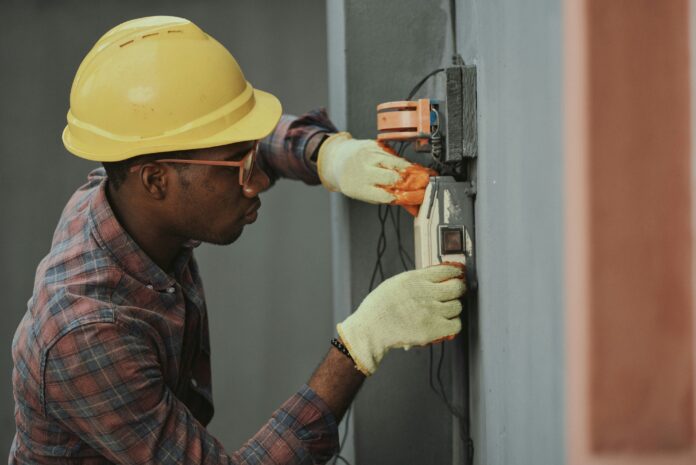
If you’re serious about a trade career, you want your hands to be busy and your skills to be genuinely valued. Becoming an electrician might be one of the best routes you can take. If you had a conversation with a friend or a job that made you realize you’d like to try being an electrician, know that this trade offers stability and earnings that go beyond many college‑based careers.
But answering the question “What education do you need to be an electrician?” isn’t as simple as going to school and getting a diploma. In the United States, you need to be ready to combine theoretical learning with apprenticeship experience, and at the end of this, pass a license exam. If your target is how to get an electrical license, you’re thinking in the right direction. This will help you get from the basics to a license, with all the key details that matter in the US.
High School or Equivalent
The first box to check is education at the high school level, or a GED. That’s the minimum foundation for most states and programs. Especially if you did courses that touch on math or physics. They are useful because you’ll see these concepts again and again in training and on the job.
But the good thing is, you won’t need a four‑year college degree to enter the field. Most successful electricians don’t follow that route at all. What matters here is more about practical knowledge and certification than an academic degree.
If you want to know more about what schooling do you need to be an electrician, read our other article, Steps On How To Become An Electrician.
Vocational Training Options
After a high school diploma, the next step is, for many people, vocational schooling. Here, you will learn the basics of being an electrician without the long haul of a traditional college degree. In the U.S., there are several ways to approach this.
Trade or Technical Schools
These courses run from six months to two years, and include labs or simulated job-site setups for practice. Some also offer job placement support after graduation.
Community College Programs
Community colleges offer certificates or associate degrees in electrical technology. These take longer than trade schools, but the upside is that you get a better and deeper learning experience. If you see yourself eventually leading a team or even starting your own business, a community college program can give you what you need.
Pre-Apprenticeship Programs
These are short-term programs that prepare you for an official apprenticeship. You’ll pick up basic safety skills, learn about tools, and understand fundamental concepts enough to make you a good candidate for an apprenticeship.
Union and Industry Programs
Some electricians start through union programs like those offered by the IBEW, or through contractor associations. In these programs, you do classroom learning as well as paid on-the-job experience. You get paid while training, and in some cases, doors open to projects you wouldn’t find on your own.
Apprenticeships Programs
If you want to become a professional electrician, sitting in a classroom and learning only the theory is not enough. It’s important to know it, but the real learning happens when you’re on a job site, working under someone who’s a lot more experienced.
Apprenticeships last around four to five years. They will teach you jobinstalling, troubleshooting, rewiring, and even that sometimes small mistakes turn great lessons. On top of that, there’s classroom instruction throughout this period that teaches you everything you need to know. By the end of it, you’ll know the standards that keep every job safe and up to code, and you’ll be a fully-fledged electrician.
There are several ways to find yourself an apprenticeship. They are offered through several channels:
- Union‑Sponsored Apprenticeships – The most common way is through the International Brotherhood of Electrical Workers (IBEW) and its training committees.
- Local IBEW JATC Programs – Many regions have their own Joint Apprenticeship and Training Committees (JATCs). One is IBEW Local 613’s program in the Southeast.
- IBEW/NECA Training Alliances – Groups like IBEW Local 743 / NECA Electrical Training Alliance also offer apprenticeships.
- Independent Electrical Contractors (IEC) – If you want to go on a non‑union route, the IEC apprenticeship program partners with member contractors.
Check out Apprenticeship.gov to find openings in your state.
How to Get an Electrical License in the U.S.
There’s no one national standard in the U.S for licenses. Each state issues its own, and even within states, there could be local rules that apply. You ned to check with your local board to be sure, but almost all the time you need to follow these rules:
Complete an Apprenticeship
You’ll work under supervision and earn your hours. Most states require three to five years of supervised work before you’re eligible to sit for the licensing exam. This is around 8000-10000 hours of work.
Pass Licensing Exams
You will have to pass a written test that covers the National Electrical Code (NEC) and local and state code variations. Some places add a business and law component if you plan to run your own shop.
Apply for the License
Proof of your apprenticeship hours, test scores, identification, and payment must be sent now. To stay licensed, you wait a set period before renewing, and this depends on each state, but it’s usually every few years.
If you want, you can continue your education to focus on a more specialized niche with more opportunities. With each exam, you go from Apprentice Electrician to Journeyman Electrician to Master Electrician.
Final Thoughts
Far from straightforward, the path to being a professional electrician draws few in at first glance. Yet step by step, focus makes progress easy, and what education you need to be an electrician will become clear. Staying on track matters more than finishing faster, because anyone ready to commit will find their way forward, no matter when they begin. You need a high school level education at minimum, some technical coursework, and the on‑the‑job training that apprenticeships provide. To legally work on your own, you need to know how to get an electrical license in your state.
This path has helped countless people build a respected career. Because power stays essential, those who handle it well are needed, and your work will be practical and rewarding.